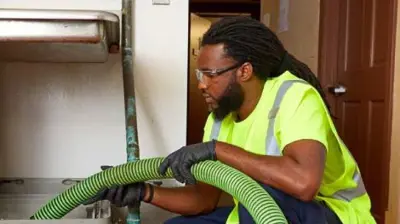


Commercial Grease Trap Cleaning
Grease Interceptor Services: We're On-Time & Available 24/7
Dealing with frustrating grease trap issues like floor backups or foul odors? We know that you don't want to shut down or lose customers due to a grease overflow, drain issues, or a non-compliant grease tank. Wind River Environmental provides emergency and routine grease trap cleaning and grease interceptor pumping for restaurants, hotels, grocery stores, food-processing facilities, and other commercial kitchens across 21 states and Washington, D.C., from Maine to Florida and west to Ohio, Tennessee, Alabama, and Mississippi. With over 75 years of grease trap cleaning experience, you can trust us to get your job done right.
Worried about local codes and regulations? We've got you covered there, too! Our local teams are up to date on the fats, oils, and grease (FOG) rules in the communities they serve, and with flexible scheduling, including night shift service, we'll work around your operating hours. We look forward to serving you!
Need a grease trap service? Call us at (877) 560-9007 or contact your local Wind River Environmental anytime. We're backed with over 75+ years of experience.
Grease Trap vs. Grease Interceptor: What's the Difference?
A grease trap and a grease interceptor do the same job. Both slow down kitchen wastewater so fats, oils, and grease (FOG) float to the top and food solids sink to the bottom, keeping FOG out of your plumbing and the public sewer. The main differences are size and location:
- Grease traps are smaller units installed inside the kitchen, usually under or next to a sink or dishwasher. They are rated by flow (gallons per minute), hold a relatively small volume, and fill quickly, so they typically need cleaning more often.
- Grease interceptors are larger tanks, usually installed underground outside the building, that hold several hundred to several thousand gallons. They serve high-volume kitchens and are typically pumped on a set schedule, often every 1–3 months.
Local codes, inspectors, and service providers often use the two terms interchangeably. Whichever your facility has, our technicians fully pump and clean it rather than just skimming the top layer.
Where We Provide Grease Trap Cleaning
Wind River Environmental provides grease trap cleaning and grease interceptor services through local teams in 21 states and Washington, D.C.:
- New England: Connecticut, Maine, Massachusetts, New Hampshire, Rhode Island, Vermont
- Mid-Atlantic: Delaware, Maryland, New Jersey, New York, Pennsylvania, Virginia, Washington, D.C., West Virginia
- Southeast: Alabama, Florida, Georgia, Mississippi, North Carolina, South Carolina, Tennessee
- Midwest: Ohio
Each local team knows the sewer authorities, health departments, and FOG programs in its area. Find your nearest Wind River Environmental location.
We Can Clean All Types of Grease Traps.2604131314102.gif)
![]()
![]()
Wind River Environmental has the expertise and equipment to clean and maintain all types of grease traps, keeping your business compliant with local regulations and your drainage system flowing.
Here are the main types of grease traps we service:
- Outside Grease Tanks. These tanks are typically located underground and can hold a large amount of grease.
- Indoor Grease Interceptors. These smaller tanks are often found inside commercial kitchens and require more frequent cleaning due to their size.
- Indirect Waste Pit and Drainage System. Similar to an indoor grease interceptor, these systems require regular cleanings to prevent clogs and backups.
No matter the type or size of your grease trap, Wind River Environmental has the expertise and equipment to provide top-quality cleaning services.
Grease Trap Services by Industry
Every commercial kitchen produces grease differently. Here is how we tailor grease trap service for the businesses we serve most.
Grease Trap Cleaning for Restaurants
Full-service restaurants, quick-service and fast-food chains, bars, and cafes send a steady stream of fryer oil, sauces, and food scraps down the drain. That means traps fill fast, and a missed service can mean a backup in the middle of a dinner rush.
- Frequency based on your volume, with service before your trap reaches 25% FOG capacity
- Early-morning, late-night, and night shift service so cleanings never interrupt service
- Service records ready for health inspectors and your local FOG program
- Schedule adjustments for busy seasons like holidays, tourist season, and football season
Grease Trap Services for Hotels & Resorts
Hotels often run several kitchens under one roof, including restaurants, banquet and catering kitchens, room service, bars, and staff cafeterias. That can mean multiple interior traps, a shared exterior interceptor, or both.
- All traps and interceptors serviced in one coordinated visit
- Frequency adjusted around conferences, weddings, and peak travel seasons, when grease volume spikes
- Discreet, off-hours service that keeps trucks, noise, and odors away from guests
- Documentation that supports brand standards and local inspections
Grease Trap Cleaning for Grocery Stores & Supermarkets
Delis, bakeries, meat and seafood counters, rotisserie stations, and hot food bars each send grease to the drain, often through several department-level traps and floor drains.
- Every department trap serviced, not just the main interceptor
- Service windows that work for 24-hour and extended-hour stores, without disrupting shoppers or deliveries
- Line jetting when slow floor drains point to grease buildup in the lines
- Consistent service and records across every store in your chain (see multi-location programs below)
Grease Interceptor Services for Food-Processing Facilities
Food manufacturers, commercial bakeries, meat and poultry processors, dairies, and central commissaries generate heavier, more continuous grease and solids loads, often through large interceptors or pretreatment systems.
- High-capacity vacuum trucks for large interceptors, pits, and tanks, on schedules as frequent as your production requires
- Service records that support your industrial discharge permit and local oil-and-grease limits
- Service planned around production shifts and sanitation windows
- Related services from one provider, including sludge removal, waste disposal, lift station services, and confined space entry
Grease Trap Programs for Multi-Location & Enterprise Accounts
Managing grease traps across a portfolio of restaurants, franchise units, hotels, or stores usually means juggling different vendors, schedules, invoices, and local rules. With more than 1,100 experts, 1,000 vehicles, and 100 local teams across 21 states and D.C., Wind River Environmental can be the single grease trap partner for every location in our footprint.
- Consolidated billing across locations
- Location-specific schedules based on each site's volume and local FOG requirements
- Centralized service records and real-time updates through our Commercial Portal, so you can see every location's service history in one place
- A consistent service process and documentation at every site, ready for audits and inspections
- Learn more about our National Program for franchises and chains, or call (877) 560-9007 to talk through a program for your locations.
Why Choose Our Grease Trap Cleaning Company?
When it comes to keeping your business running smoothly and staying compliant, choosing the right grease trap cleaning partner is crucial.
Why choose us? Here are a few reasons:
- Reliable 24/7 Emergency Response. Unexpected backups or overflows can cripple your operations. We're available around the clock to minimize downtime.
- Unwavering Commitment to Compliance. Navigating local regulations can be complex. We follow your local sewer authority and board of health requirements, including proper documentation and disposal.
- Service That Works Around You. We understand the demands of your business. We'll work around your schedule to avoid disruptions.
- One Partner for Every Location. With 100 local teams across 21 states and D.C., we can service every site in your portfolio.
- Decades of Trusted Expertise. With over 75 years in the industry, we bring unparalleled experience and knowledge to every service.
Grease Trap Leaks & Repairs
A leaking or damaged grease trap is more than a mess. It can let untreated grease reach the sewer or surrounding soil, cause persistent odors, and put your business out of compliance. Catching problems early usually means a simpler, less expensive repair.
Signs Your Grease Trap Is Leaking or Damaged
- Water or grease pooling around the trap, lid, or nearby floor drains
- Odors that linger even right after a cleaning
- Grease building up in downstream lines even though the trap was recently pumped
- Cracked, warped, or missing lids, gaskets, or baffles
- Corrosion on steel traps, or cracking and settling around concrete tanks
What to Do If Your Grease Trap Is Leaking
- Limit water use. Reduce what goes down kitchen drains to keep the trap from overflowing.
- Contain the area. Keep staff and customers away from slippery spots and use absorbents. Never hose grease into floor or storm drains.
- Call us 24/7 at (877) 560-9007. We'll pump the trap down so it can be properly inspected.
- Find the source. We inspect the lid, gasket, baffles, tees, inlet and outlet pipes, and tank walls.
- Repair or replace. Many leaks are fixed by resealing the gasket or replacing a lid, baffle, or tee. Heavily corroded or cracked units may need grease trap replacement.
Frequently Asked Questions
What is the difference between a grease trap and a grease interceptor?
Both capture fats, oils, and grease (FOG) from kitchen wastewater before it reaches the sewer. A grease trap is a smaller unit installed inside the kitchen, usually under or near a sink, and needs frequent cleaning. A grease interceptor is a larger tank, usually installed underground outside the building, that serves high-volume kitchens and is pumped on a regular schedule. The terms are often used interchangeably.
How much does grease trap cleaning cost?
Grease trap cleaning cost depends on several factors:
- The type and size of the trap or interceptor (gallons pumped)
- How full it is and how long it has been since the last service
- Routine service agreements vs. one-time or emergency calls
- Access, location, and after-hours scheduling
- Disposal fees and local documentation requirements
- Add-on services such as line jetting
As a general guide, routine cleaning of a small indoor grease trap typically costs less per visit than pumping a large outdoor interceptor, and scheduled service usually costs less per visit than emergency service.
How often should grease traps be cleaned?
Grease traps should be cleaned every 1-3 months, depending on the size and volume of your commercial kitchen. However, it is always best to consult a professional to determine the appropriate frequency for your business.
Many towns and states have grease tank servicing requirements under their FOG Program. Our maintenance program ensures your grease tanks are serviced for efficiency and compliance, helping you avoid violation fees.
Why should my grease trap be cleaned so frequently?
Cleaning your grease trap every 3 months helps prevent clogged drains and other expenses like drain repairs and fines from the health department. Essentially, routine grease trap cleaning is more cost-effective for you in the long run.
Grease traps, also known as grease interceptors or grease recovery devices, are essential for removing fats, oils, and greases (FOG) from wastewater. These traps can clog fast without regular cleaning, making your property vulnerable to issues.
Common issues from a neglected grease trap include:
- Fire hazards due to build-up of combustible materials
- Foul odors from trapped food particles and bacteria growth
- Expensive plumbing issues from clogged pipes and drains
- Health code violations and potential fines
Without regular cleaning using proper techniques, a grease trap can become a liability for your business. Stay compliant and prevent issues by scheduling routine cleanings with Wind River Environmental.
What records do I need to keep for my grease trap?
Requirements vary by location, but most FOG programs expect a grease log or service record showing the service date, the company that performed it, and the technician's name, along with pumping manifests. In Massachusetts, we also file a DEP Form 4 with your local Board of Health for exterior grease tank services. We document every service so your records are ready for inspections.
What are the signs I need to have my grease trap cleaned?
Common signs that your grease trap could use a cleaning include:
- Slow draining or clogged sinks, indicating a buildup in the trap
- Unpleasant odors coming from drains or the grease trap area
- Standing water or sewage backups near the grease trap
- 25% or more of the trap's capacity is filled with FOG
Ready to book your grease interceptor cleaning? Give us a call at (877) 560-9007 or get an estimate.

Our Grease Trap Cleaning Process: What to Expect
While some companies only scoop out the top layer, our technicians fully pump down your grease trap. We'll also inspect the inlet and outlet pipes, flow, and grease thickness. Our process helps you avoid backups and compliance issues.
Here's what you can expect during your grease trap cleaning service:
Interior Grease Traps
- Step 1. We begin by safely removing the top cover of your interior grease trap.
- Step 2. We thoroughly pump out all grease, water, and solid waste from the containment area.
- Step 3. We clean the entire containment area, including all baffles and strainers.
- Step 4. We clean and inspect the gasket. If needed, we'll reinstall it, resealing with caulking to prevent leaks.
- Step 5. We run water from your sink through the traps to verify proper flow and identify any immediate drainage issues.
- Step 6. We conduct a visual inspection of the trap for any structural damage or potential problems.
- Step 7. If required by your local health department, we complete an IG service grease log.
-
Unrivaled NetworkOver 1,100 experts, 1,000 vehicles, and 100 local teams united.
-
Complete SolutionsFrom clogged drains to flooded streets, we've got you covered.
-
Legacy of ServiceOver 75 years of dedication to our valued customers.
-
Real-Time UpdatesReceive detailed reports and real-time reporting from our technicians.

Hear From Our Happy Customers
-
“The technician was very helpful and gave me several ‘pointers’ about what we could do to help get the most out of our septic system.”- Stephen F.
-
John Gilles performed our septic pump on 10/10/25. After the pump was completed, he asked me to flush each toilet a few times to make sure things were looking good. He also gave me advice on how to tell the tank is full and to prevent issues, since we should have had it pumped sooner than we did. He did a great job putting the dirt back afterwards since he had to dig to get to the tank. He was funny too! Great service, would be glad to have him again. By the way, the new online ordering system is much better. I'm glad it pulls details in from past orders now so I no longer have to re-enter them manually. Much quicker, thank you for that improvement!- Alicia Lacroix
-
I spoke to the technician who pumped my tank Steve S and he was very personable and knowledgeable. My wife was watching Steve S cover hole that he dug up to pump my septic tank, and said that person really takes pride in his work because of the care he took to make it look natural again. I went out and told Steve my wifes comments because people seem to only hear the bad comments.- randy l
-
“What made them stand out was they are willing to handle all aspects of what we were asking so that we have a complete plan in place.”- Nick Jaggi - Facilities Director, Warwick Mall
-
“Wind River was there in less than two hours and were like a white knight on their steed. Of course I became a big fan.”- Gene Shoemaker, Business Owner