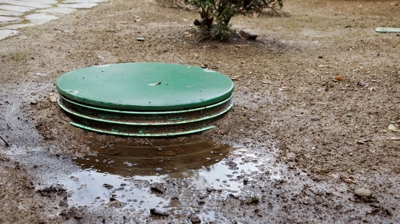
Conventional septic systems aren’t the right fit for every person or property. ATU systems provide an efficient alternative that may better suit your setup.
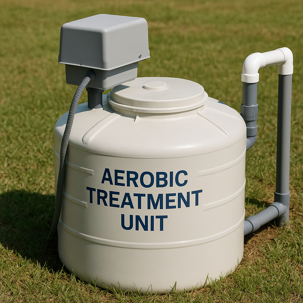
An ATU (Aerobic Treatment Unit) treats waste via aerobic processes (vs. anaerobic, as with a typical septic system). Aerobic bacteria actually perform more efficiently than anaerobic, but—and here’s the clincher—they do need oxygen. That means an ATU requires oxygen to be injected into the tank to function accordingly.
To achieve this oxygen infusion, electricity is needed. That’s the biggest drawback to an ATU: Because electricity and oxygen are essential, an ATU system has more functioning parts, which can translate to more maintenance and upkeep. That said, ATU systems can still be a great choice for homeowners. Plus, one major advantage: They don’t need the same-size drain field as a traditional septic system—and can even use drip irrigation for the drain field—so homes can be built on small lots or on forested land, without the need to clear a big area.
Here are the central components of an ATU:
• Pretreatment Tank
Your house’s main sewer line empties into this tank. It’s where solid waste stays while effluent (liquid wastewater) continues on to the ATU. This can either be a separate tank or part of your ATU.
• Aerobic Treatment Unit (ATU)
This is where an ATU’s distinct attributes come into play. Aerobic bacteria break down waste particles in the water, thanks to oxygen injected into the unit that kickstarts the process. Typically, the water will keep flowing into a clarifying chamber or pass through a chlorinator for additional purification before advancing to the pump tank.
• Pump Tank
Post-treatment, water comes into the pump tank, where it’s then distributed onto the soil via an irrigation system (like sprinklers or drip irrigation). Microbes in the soil complete the purification process, and the water returns to groundwater to be reused. Pump tanks are only needed for drip irrigation or if the drain field elevation is higher than the plumbing elevation of the house. Otherwise, an ATU can be gravity-fed, removing a pump tank from the equation.
In addition to an ATU’s space benefits, it also operates with natural processes (like a septic system and drain field do) by pumping oxygen to perform wastewater treatment. Although this requires a different configuration, these systems are nonetheless easy to maintain and relatively affordable to purchase.
Regulations are catching up to the popularity of ATU systems, especially for residential properties and rural lands that aren’t eligible for septic systems. ATUs can also mitigate pollution of groundwater, providing a bonus safety benefit to boot.

The Benefits of an ATU System
Categories: