

A septic tank is an underground wastewater treatment system commonly used in rural and suburban areas without access to centralized sewer services. It collects wastewater from your sinks, toilets, showers, washing machine, and other plumbing fixtures.
Here’s how a septic system works:
- Wastewater leaves your home and flows into the septic tank.
- Inside the tanks, solids settle to the bottom as sludge, while oils and grease float to the top as scum.
- The liquid wastewater (effluent) flows out of the tank and into the distribution box, which sends it to the drain field (leach field).
- The soil naturally filters the wastewater, removing harmful bacteria and impurities.
- Meanwhile, bacteria inside the tank break down solids into liquid, allowing them to eventually flow out to the drain field as well.
If your home has a septic system, you will find the septic tank buried somewhere on your property. Most modern systems include several important components that must function properly to avoid costly repairs.
Where is My Septic Tank Located?
Your septic tank, distribution box, and drain field are all buried underground and connected to your home by pipes.
To locate your septic tank:
- Check your property records for a septic system map.
- Look for discolored or unusually lush grass.
- Search for subtle soil depressions where the tank is buried.
- If you’re a Wind River Environmental customer, the location is already on file.
- If not, we offer professional septic tank locating services.
If you’re a Wind River Environmental customer, we already have this information for you, and if you aren’t yet, we provide locating services.
Main Components of a Septic Tank
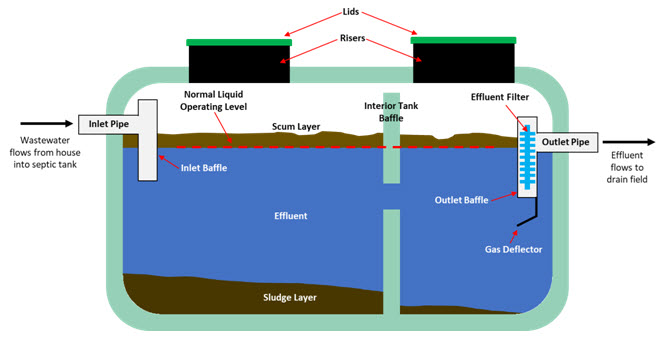
A typical septic tank system includes the following six essential parts:
The Tank
A watertight holding tank where wastewater from your home collects. It must remain structurally sound with no cracks or leaks.
Access Ports
Access ports allow certified septic professionals to pump and clean your tank.
Many homeowners install risers to bring the access ports up to ground level – saving time and money during pumping. For the security of your family, access lids must always be child-proof, secured with screws, and free of cracks.
Inlet Baffle
The inlet pipe brings wastewater from the home to the tank.
The inlet baffle is responsible for:
- Preventing scum from entering the inlet pipe.
- Slowing the incoming wastewater so solids can settle calmly.
- Helping prevent odors from traveling back into your home.
Outlet Baffle
The outlet pipe, positioned about 3 inches lower, carries effluent to the drain field after solids settle.
The most important baffle – this piece prevents solids and scum from entering the outlet pipe and reaching the drain field, helping protect it from clogging.
Gas Deflector & Effluent Filter
Gas deflectors stop rising gas bubbles from carrying solids into the outlet pipe.
An effluent filter adds extra protection by catching solids before they reach and damage the drain field.
If any of these parts are missing, damaged, or failing, contact one of our septic professionals immediately.
How to Maintain a Healthy Septic System
Keeping your septic system in good working order helps prevent breakdowns, backups, and expensive repairs.
Avoid Flushing or Draining Harmful Materials
Only flush septic-safe materials – primarily wastewater and human waste. Avoid flushing wipes, grease, feminine products, chemicals, or anything not labeled “septic safe”.
Maintain Proper Bacterial Levels
The natural bacteria in your septic tank break down solids. If household cleaners or chemicals disrupt this balance, you may need septic additives to restore healthy bacterial levels.
Schedule Preventative Maintenance
Regular septic maintenance helps avoid emergencies.
Essential maintenance includes:
- Pumping your septic tank.
- Cleaning your effluent filter.
- Adding septic treatment products when needed.
Most septic tanks need pumping every 3-5 years, depending on household size, tank, size, and usage.
Are you in Pennsylvania? The Pennsylvania Septage Management Association (PSMA) recommends that you get your septic tank pumped every 2 to 3 years.
If your tank becomes over 1/3 full of scum and sludge, the solids will stay in the effluent and flow into your pump tank or drain field, causing severe damage. Replacing your drain field can cost tens of thousands of dollars (we want you to avoid this at all costs!).
Is your septic tank full? Good news - you can check yourself! Here's a guide to help you check whether your septic tank is full.
Wind River Environmental also offers pumping, drain cleaning, and treatment additives for complete system care.
Need Help with Your Septic Tank?
Whether you’re new to septic system ownership or need help maintaining your current system, Wind River Environmental is here to help.
Contact us today to schedule pumping, inspection, or maintenance services.